SEO & Paid Marketing: What Changed in 2025
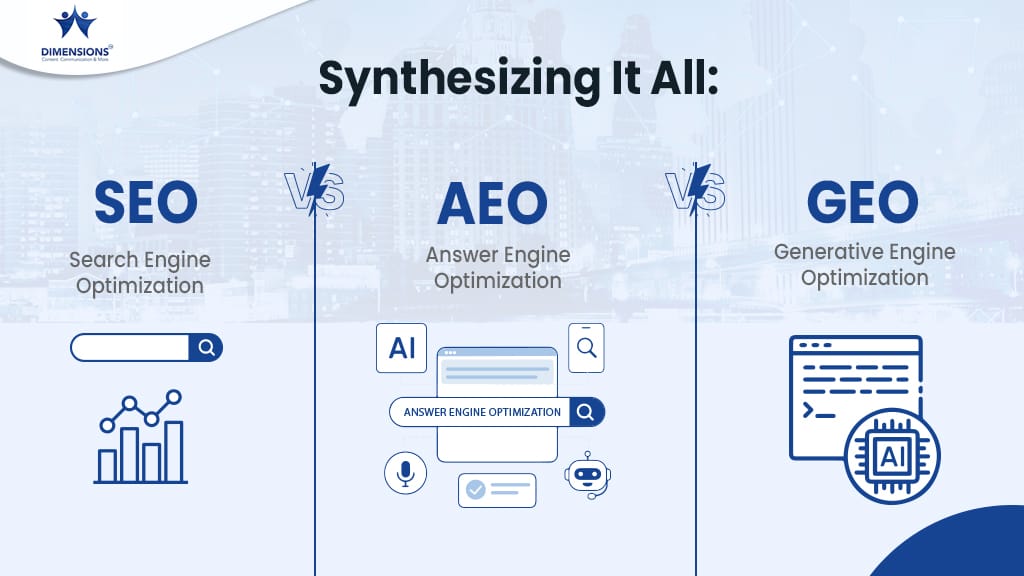
AEO, GEO (and a lot of misinformation about them)
2025 has been the year of mass adoption of AI tools for general web search. The initial friction is gone. People are now using ChatGPT or Gemini to search. Even the native Google search screen is now dominated by AI overviews.
And with the introduction of these acronyms, confusion did not take much time to creep in. Let’s first clear the air:
AEO Has Been There Before AI or LLMs
Contrary to popular AI SEO “gurus,” AEO is not a new thing. It’s Answer Engine Optimisation. Answer engines can be many things – it can be the structured snippet that you see on Google search (not the AI-generated ones).
For example, if you search for “Dimensions Content contact number” on Google, you’ll see this:
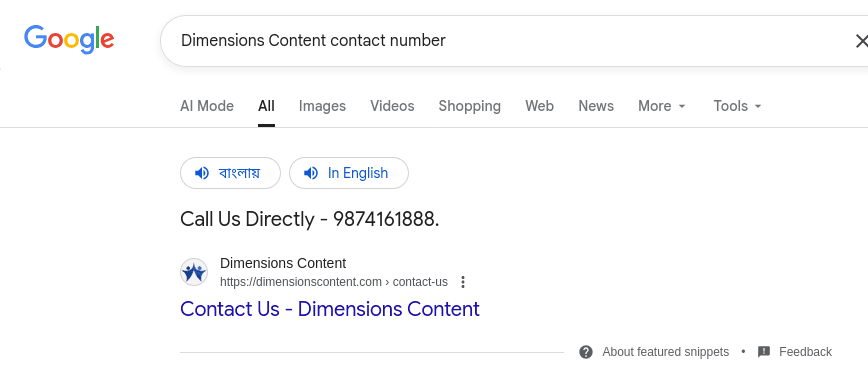
This is a featured snippet – not an AI-generated answer.
SGE/AI Overviews – The New Hype In The World of SEO In 2025
Google introduced Search Generative Experience (SGE) in 2023. And it got mass adoption in 2024-2025. Today if you search on Google, you’re greeted with an AI-generated list of search results and explanations. That’s what we call SGE or AI Overviews.
For example, if you search on Google, ‘Why Dimensions Content Is Considered a Responsible Agency’, you get this:
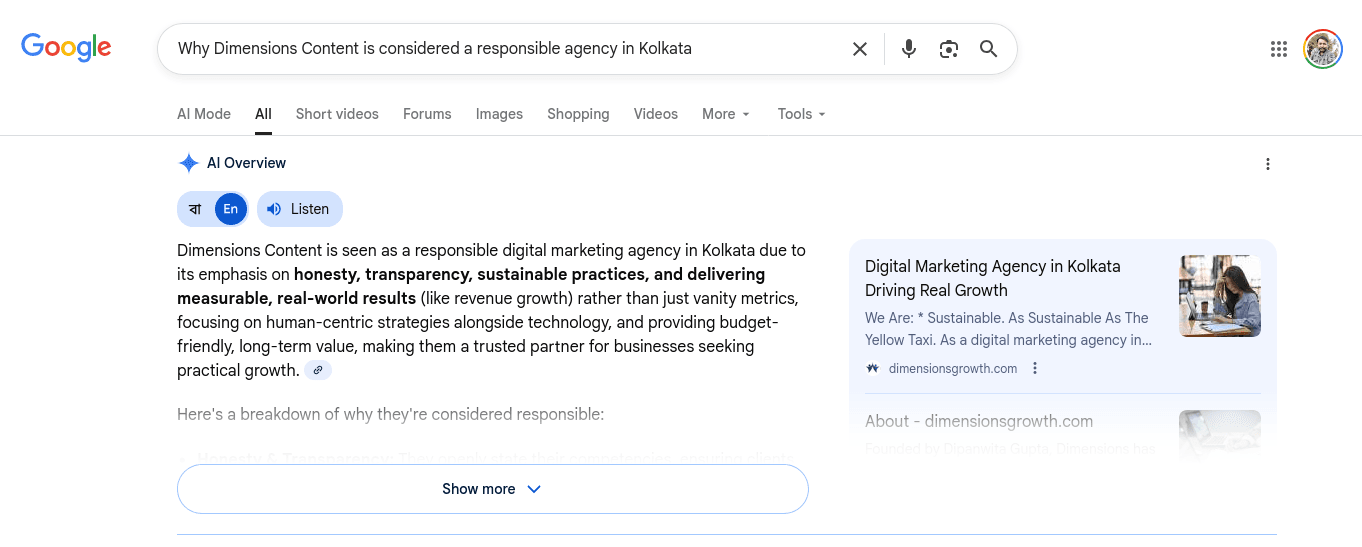
Basically:
- Google now uses AI to understand the CONTEXT of the search
- Google uses AI to synthesize the content of the website indexed by it
- Finally, Google uses AI to generate the CONTENT based on CONTEXT
Look at the underlined word – generate. That’s exactly why appearing in AI overviews is called Generative Engine Optimisation.
ChatGPT As a Search Platform
After the initial hype cycle of novelty, people are now putting ChatGPT to real work. Around 1% of referral clicks to websites came from ChatGPT alone in 2025. That’s 1% of the world’s clicks. That’s huge!
And then there are people who are now performing their initial research with ChatGPT (or Gemini or Perplexity). So, for example, before searching on Google, people now tend to search on ChatGPT – “Reliable digital marketers in Kolkata”.
Optimising your content for AI platforms is the next stage of SEO.
Misinformation on GEO/AI Overviews
Whenever the world witnesses a new innovation, it also sees a rise in snake-oil salesmen selling solutions associated with the innovation. Remember the hype around crypto and Web3 a couple of years ago?
With GEO, a new breed of fake SEOs has emerged. They advertise themselves as “GEO experts”, promising a guaranteed appearance in AI overviews and ChatGPT.
But,
SEO is deterministic; GEO is non-deterministic. Similar prompts can generate dissimilar results.
The dust hasn’t settled yet. No one knows for sure what works in terms of GEO/AI overviews. In fact, leading and authentic SEO experts like Lily Ray say, “…there is a huge overlap between the sites that do well in SEO and the sites most frequently cited in AI answers.”
This means traditional SEO best practices still rule. They are the ones that will help your website rank in AI Overviews and get referenced by ChatGPT.
The bottom line is – Traditional SEO is not that. On the contrary, its value increased manifold in 2025.
What All Happened in the World of Paid Ads In 2025
Both Meta and Google added AI tools to their ad platforms that are supposed to help us. However, use them with caution, as they are known to make advertisers bleed more money before the results start showing.
- Meta doubled down on their Advantage+ AI modules with their “Opportunity Score”. Basically, the more Advantage+ suggestions you followed, the higher score you got. (Psst! You should not accept all suggestions.)
- Improved partnership ads on Facebook and Instagram with better insights, an expanded hub, a new API, and simpler creator permissions.
- Finally, Meta has rolled out ads on WhatsApp status. This is good news for advertisers. They can now reach their audience in a more intimate way – WhatsApp is considered a personal platform, unlike Facebook.
The Google Ads platform too brought some significant changes:
- More focus has been given on compliance. You now have to declare whether your ad is political in nature – even if the country is not relevant in terms of demographic targeting.
- Performance Max was a central focus with two key updates: advanced automation tools and improved measurement capabilities
- The ‘Click To WhatsApp’ option via message assets – that was rolled out in 2024 – saw a significant adoption in 2025. This has been done to specifically catch up with Meta’s CTWA ads option.
- Google launched a Gemini-powered tool called Ads Advisor that can analyse campaigns, help you troubleshoot ad-policy issues, etc. While much is to be desired, the tool seems to be promising.
2026 SEO & Paid Ads Outlook: What to Expect
There are two types of AI features: AI slop and actually useful AI features. In 2026, you have to make sure that you use only those AI features that are useful to you.
Google Ads is going to bring back its landing-page testing tool. It will now be integrated with GA4. This might perhaps be the single biggest piece of good news in the industry in 2026. The tool will immensely help advertisers judge the strengths of the landing pages – what those landing pages lack and what should be added.
Caution: The “Human Premium” in SEO If you have become too comfortable posting AI-generated content on your website and social media, stop right now. As the internet floods with generic, LLM-generated articles, Google’s algorithms are expected to swing the pendulum back toward radical authenticity. Our Prediction: Google will reward firsthand reviews/demos of products, real images, and heartfelt blogs more in the coming months. This is not a sentimental assessment; this is cold business logic. AI slop makes the web less attractive. This will lead to fewer users. People would love to stick to closed platforms. This will be bad news for Google. And we are very sure that it will act before it’s too late. Today’s AI slop will lead to tomorrow’s SEO penalty. |
Digital PR and Off-Page Citation Will Be In Focus In 2026
If you search on ChatGPT – Best Air Conditioners In India – you’ll likely see Voltas or LG or Daikin being mentioned. Why? Because their websites – no, their BRANDS – carry authority. This year, don’t just focus on your website. Focus on your brand. Invest in digital PR and organic off-page citations. These are the only two reliable ways to increase the weight of your brand. And this is necessary to be cited by AI tools.
Above all, context is king. Move beyond simple keyword-centric digital marketing. Build context around your business. Answer the whys and hows of your business.
Content Marketing
Key Shifts in 2025
A gradual move from volume to value has defined the marketing landscape, where high-output content strategies start losing impact. Since the audience is guided by smarter algorithms and sharp intent, marketing success depends on credibility, relevance, and the smarter use of technology rather than sheer output.
- Content moving from volume to value
Content has moved way beyond just giving information. Rather, it has become a decision-making driver. Moreover, with AI-focused search, where low-impact materials are easily filtered out, the audience gets more engaged with content that is purposeful, in-depth, and relevant.
- Rise of authority-led, experience-backed content
With AI on the scene and generic content being quite easily accessible, the key differentiator is certainly credibility. In such a saturated landscape, audiences get engaged by insights grounded in real expertise and original thinking instead of templated outputs.
- AI as an assistant, not a replacement
Marketing is always human-led, where AI only enhances the process. While AI helps in accelerating research, ideation, and execution, strategic thinking rests on human judgement, and no artificial intelligence could replace that. For successful organisations, AI works as a productivity layer and not a decision-maker. The more you balance the same, the more scalable your marketing efforts will become.
Content Trends for 2026
As mentioned earlier, value speaks louder than volume as far as the content strategy is concerned. As a result, the focus is shifted towards quality cohesion and trust. As brands look forward to standing out in an AI-saturated world, here are three leading trends that are going to position them better in an increasingly discerning audience.
- Trust-driven storytelling and thought leadership
Storytelling will focus less on promotion and more on credibility. Clear thinking, informed opinions, and a consistent point of view are gaining traction. Thought-leadership rooted in data and perspective plays a key role in building long-term trust.
- Content ecosystems over one-off posts
Being disconnected, one-off pieces are losing relevance to an informed audience. What gains attention today is a content ecosystem, where interlinked articles, videos, newsletters, and assets guide audiences across the journey. It’s an integrated journey that reinforces messaging and improves recall, eventually leading to intent-led discovery, which is otherwise not possible in a fragmented approach.
- Human tone, real insights, sharper editorial standards
With AI-generated content being extremely commonplace, editorial discipline is a magic potion. Instead of generic phrasing and templated narratives, real insight with a human tone wins hearts. Credible brands separate themselves from automated noise by being human.
2026 will surely see the rise of more ‘useful’ and ‘context-orientated content’ and not just the old-fashioned content driven by the age-old keyword logic.
Podcasting — Long-Form Content, Long-Term Trust
Podcasting has steadily evolved into a credibility-building medium rather than a supplementary content format. As attention spans fragment and trust becomes harder to earn, long-form audio is emerging as a strategic channel for sustained influence and authority.
How Podcasts Evolved in 2025
In 2025, podcasts moved beyond experimentation and became a key player in structured brand strategy. They became a space for depth, perspective, and consistency, which were increasingly missing from fast-paced digital feeds.
- Podcasts moving from “nice-to-have” to a brand authority tool
Podcasts shifted from optional content initiatives to intentional authority platforms. Brands used them to articulate viewpoints, explain complexity, and demonstrate long-term thinking. Consistency of voice and subject matter helped build credibility over time. Authority was earned through conversation, not promotion.
- Rise of founder-led and niche-expertise podcasts
Founder-led and specialist-driven podcasts gained momentum as audiences sought authentic, first-hand insight. These formats offered unfiltered access to experience, decision-making, and industry nuance. Niche expertise outperformed broad commentary in engagement and trust. Personality and perspective became key differentiators.
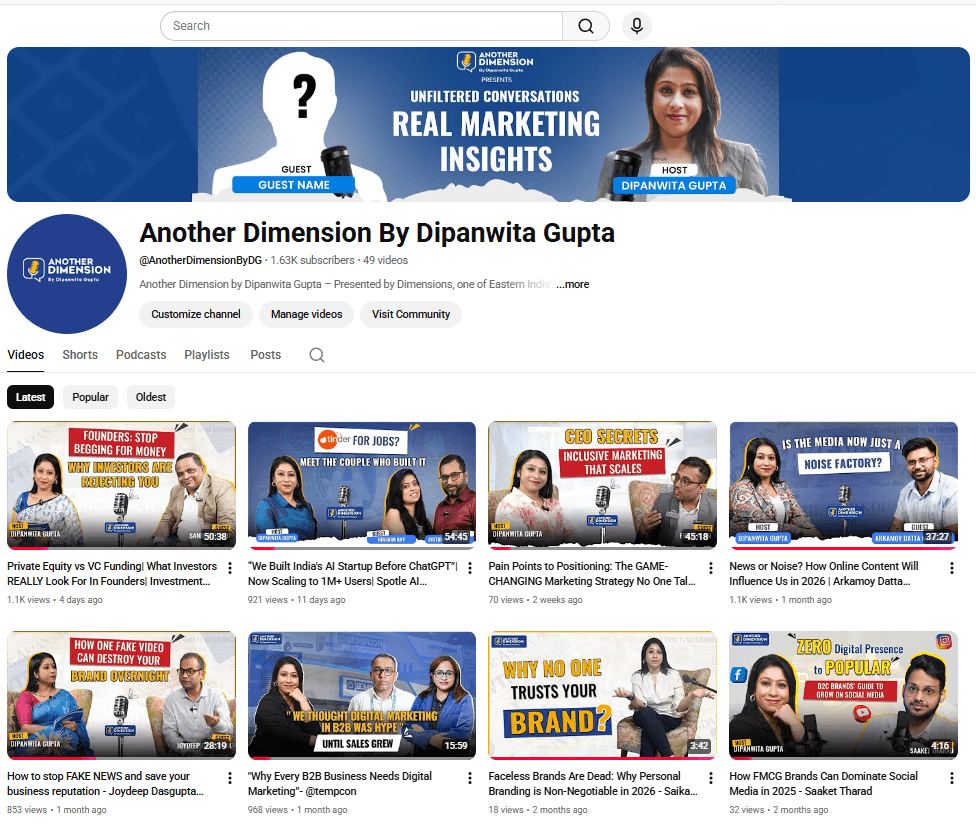
Dimensions launched their YouTube-based podcast channel, ‘Another Dimension By Dipanwita Gupta’, hosted by the founder herself – in August 2024, and within a span of 5 months, the channel garnered decent views and subscribers. Despite its specialised theme of discussion – marketing & technology trends – it has been successful in reaching out to a niche audience which is a sizeable one, thanks to the insightful discussions it presents and the value it gives to the decision makers out there.
- Audio-first storytelling creates deeper, distraction-free engagement
Audio emerged as a rare format enabling sustained attention in a multi-screen environment. Listeners engaged for longer durations without visual distractions. This allowed for more thoughtful storytelling and layered narratives. Depth, rather than speed, became the podcast’s core strength.
- Repurposing podcasts into blogs, reels, shorts, and newsletters
Podcasts increasingly acted as anchor content within broader ecosystems. Episodes were broken into blogs, short videos, social clips and newsletters. This extended reach while preserving narrative consistency. Long-form conversations powered multiple high-impact touchpoints.
Why Podcasts Matter More in 2026
As digital noise intensifies, podcasts are becoming a reliable medium for trust-led communication. In 2026, they are positioned as long-term brand assets rather than short-term content plays.
- Trust-led marketing in a low-attention, high-noise world
Podcasts foster trust by creating uninterrupted, intimate engagement with audiences. Listeners choose to spend time, not scroll past. This depth of attention strengthens credibility and recall. Trust is built gradually, not algorithmically.
- Podcasts as content IP, not campaigns
Brands are beginning to treat podcasts as owned intellectual property. The focus is shifting from episodic promotion to long-term value creation. Podcasts now anchor broader content and thought-leadership strategies.
- Video podcasts fueling YouTube, LinkedIn, and social discovery
Video-first podcast formats are expanding discoverability across major platforms. Clips and full episodes drive awareness while maintaining conversational depth. This hybrid model balances reach with authority. Visibility no longer comes at the cost of substance.
- Brands owning conversations instead of chasing reach
Podcasts allow brands to shape narratives rather than follow trends. By owning conversations, brands establish direction and relevance. Influence comes from perspective, not volume. In 2026, control of dialogue is a competitive advantage.
Social Media & Video Marketing
How 2025 Redefined Engagement
- Short-form video dominance across platforms
If there’s any format that ruled the internet in 2025, it’s definitely the short-form videos. Thanks to the shrinking attention span that gains views for these videos. They keep users engaged for longer periods. Platforms heavily leaned on this shift.
Reels, shorts, and vertical videos not only become a tool for aggressive promotion; rather, they become the medium to keep people scrolling, watching, and coming back for more. A 30-second reel can capture the core idea which once required a 9-minute video.
That said, this shift does not signal the demise of long-form content. It’s still there and became more about depth, trust and authority, while short-form took over discovery and reach.
Precisely, engagement in 2025 is defined by speed, clarity, and instant value, which is going to be the mantra of 2026 as well.
- Lower organic reach, higher emphasis on relevance
Organic reach didn’t just fade over time; it came from a strategic shift in how social media chose to make money. Social platforms began tightening their focus on revenue, reshaping their ecosystems around monetisation rather than discovery.
The center stage now belongs to:
- Paid advertising
- In-app marketplaces
- Business messaging tools
That change quietly rewrote visibility. Brands and creators could no longer rely on organic distribution alone and were pushed towards paid reach. What still cut through the noise was not polish, but relevance.
Content that connected emotionally, whether it sparked curiosity, tapped into desire, played on fear, or felt instantly relatable, travelled further than technically flawless content. Engagement turned into a psychological game.
- Communities over followers
2025 made it clear that followers are not synonymous with real influence. What actually mattered was community. Creators and brands began shifting away from chasing large but quiet audiences and started paying attention to the people who genuinely showed up, listened and engaged.
Building a community looked very different from traditional growth tactics. It meant:
- showing the human side of the brand
- being open about both wins and setbacks
- letting personality lead instead of aiming for perfection
- starting conversations rather than simply pushing messages out
The impact was clear. A small, engaged group of 200 people often created far more value than tens of thousands of passive followers. Trust, consistency and genuine connection emerged as the real forces behind meaningful engagement.
Where Social & Video Are Headed in 2026
- Video-first brand narratives
Storytelling continued to deliver strong results, largely because it connects with people on an emotional level. Video became the preferred medium, not just for visibility but for building trust. More founders began speaking directly to their audiences on camera, often using their own products, while employees also emerged as credible brand voices.
Content formats found clearer roles. Short videos worked best for grabbing attention, while long-form videos were used to add depth, context and useful information. Used together, both formats helped brands communicate more effectively.
- Creator-brand hybrids and UGC credibility
Brands began shifting away from aesthetic content towards proof-based storytelling. As a result, creators and influencers could no longer rely on visuals alone to drive purchases. Value, experience and authenticity became essential.
Creators who produced honest, experience-driven content started earning more trust from brands, even if their follower base was smaller. In an increasingly saturated social media space, trust became a key differentiator, making strong user-generated content more valuable than ever.
- Performance-led social content, not just visibility
Social strategies became far more outcome-focused. Organic content still played a role but was used selectively, while paid ads moved from being optional to essential. Content was no longer posted for visibility alone; each piece was tied to a specific goal.
Engagement metrics also evolved, where just likes and views stopped being a big deal, while comments and shares became stronger indicators of real interest. Chasing virality proved ineffective, often delivering reach without relevance and audiences that failed to engage over the long term.
Photography & Graphic Design — The Backbone of Branding
Nowadays, a lot of people who scroll, recognise pictures that are genuine, trustworthy and emotionally sincere rather than memorable phrases. For this reason, rather than decoration, brands now use photography and layout as their primary language. In 2025, many photographers, creators and platforms pushed authenticity over polish, responding to filtered-feed fatigue and shifting visual storytelling toward genuine, documentary-style narratives.
Photography Developments in 2025 and 2026 Trends
Photography in 2025 transformed dramatically, with AI integration and authenticity reshaping workflows and aesthetics.
Key Events in 2025
- AI photo editing becomes the default: AI tools like Lightroom AI, ImageEdit with Nano Banana, and Pro automated masking, skin cleanup, lighting, and stylistic changes slash hours of Photoshop work to just prompts. This boosted speed for commercials, editorials, portraits, and campaigns, sparking debates on transparency and authenticity. Also, this increased the workflow.
- Rise of raw, unfiltered shots: Influencers and photographers pushed candid over polished, using natural light and imperfections to combat filter fatigue, dominating Instagram with real-life B-roll.
- Platform consistency mandates: Daily shooting and unique styles emerged as pros rejected blurs, focusing on moody colours for brand identity.
- Interactive social visuals: Behind-the-scenes and user-generated content surged, enhancing engagement across feeds.
2026 Trends to Adopt
- Cinematic photography explodes: cinematic lighting, vintage/teal-orange grading, letterboxing, and VFX like flares create movie-frame vibes, fuelled by streaming nostalgia for fashion, portraits, and music covers.
- Candid and authentic dominance: Grainy, blurry, unposed lifestyle shots celebrate diversity, countering AI perfection with honest street energy and real bodies.
- Motion-infused stills: Subtle animations and depth effects add narrative power, making images immersive.
- Sustainable, ethical visuals: Eco-focused, transparent creation emphasises human stories over manufactured looks.
Graphic Design Developments in 2025 and 2026 Trends
Graphic design between 2025 and 2026 reflects a clear shift in creative values. In 2025, the industry focused heavily on refinement, speed, and technological mastery.
Key Developments in 2025
- AI Evolution: AI became a productivity powerhouse, generating polished mockups instantly with clean digital styles, blending colours seamlessly. Brands adopted it rapidly for high-quality visuals, marking “tech-first” prestige, though uniformity blurred distinctions.
- Sustainability Practices: Earthy palettes, leaf motifs, and kraft paper aesthetics signalled eco-friendliness superficially, aligning with consumer demands via literal green cues on packaging and sites.
- Interactive Trends: Scrollytelling and micro-animations created frictionless experiences with parallax depth, turning sites into immersive playgrounds that retained attention through seamless motion.
- Typography Innovations: Expressive serifs, variable fonts, and Y2K chrome/liquid effects animated text dynamically, often replacing photos as focal points while maintaining legibility.
2026 Trends Emerging From These
- AI Adaptation: Shift to an “AI with an artisan soul” kind of vibe, coding for rough bases, adding noise/grain manually to hide algorithms, and rejecting 2025 sterility for hybrid humanity.
- Sustainable Innovations: Radical transparency with dark modes, low-data designs, and elemental folk aesthetics emphasising “less is enough” over performative greens.
- Tactile Interactivity: Brutalist anti-design with overlapping, resistant elements, haptic feedback, and chaotic responses for emotional, imperfect physicality.
- Imperfect Typography: Rough, artisanal fonts amplify warmth and chaos, extending 2025 boldness into human-centred narratives.
Bringing It All Together
The Big Picture:
2025 showed us that marketing success lies in integration—strategy, creativity, data, and human insight working together. 2026 will reward brands that are intentional, consistent, and experience-driven, not those chasing every new trend.